Thanks!
If you liked this, we would love for you to share it with more people.


.png)

Hiring locally has become slower and more expensive than ever. In North America, senior developers can cost nearly $200,000 per year, and filling roles often takes months. Meanwhile, demand for skilled developers continues to outpace supply across North America and Western Europe.
Outsourcing can help, but only if you know where to look. Each country has its own strengths, costs, and workflows, and picking the wrong one can waste time, money, and momentum.
As more organizations turn to software development outsourcing, it is crucial to understand what each country excels at and which types of projects they are best suited for, because not all outsourcing destinations are created equal.
Outsourcing software development is about trusting someone else with your vision, and that can feel a little scary. You want people who get it, who care as much as you do, and who won’t drop the ball when deadlines hit or priorities shift.
Freelancers can be great, but if someone gets sick or disappears at crunch time, it’s on you. Agencies, on the other hand, show up with structured teams, project managers, and processes that keep things moving—even when life happens. It’s peace of mind, and sometimes that’s worth more than the hourly rate.
That’s why many companies choose to build dedicated development teams that operate as long-term extensions of their internal product departments.
Outsourcing also brings flexibility and innovation. Software agencies can scale resources as your project grows, apply the latest tools and technologies, and provide long-term support. With the right team, you get a partner who helps your vision come to life without burning you out.
The best outsourcing destinations consistently share several characteristics.
First, they invest heavily in STEM education, producing technically strong engineers. Second, English proficiency and cultural compatibility allow seamless communication with international clients. Third, they offer competitive cost structures without sacrificing quality.
Beyond talent and pricing, the maturity of the local tech ecosystem matters. Countries with thriving startup scenes, R&D investment, and strong regulatory environments tend to produce more product-minded developers.
With those criteria in mind, here are the top countries leading the outsourcing landscape in 2026.
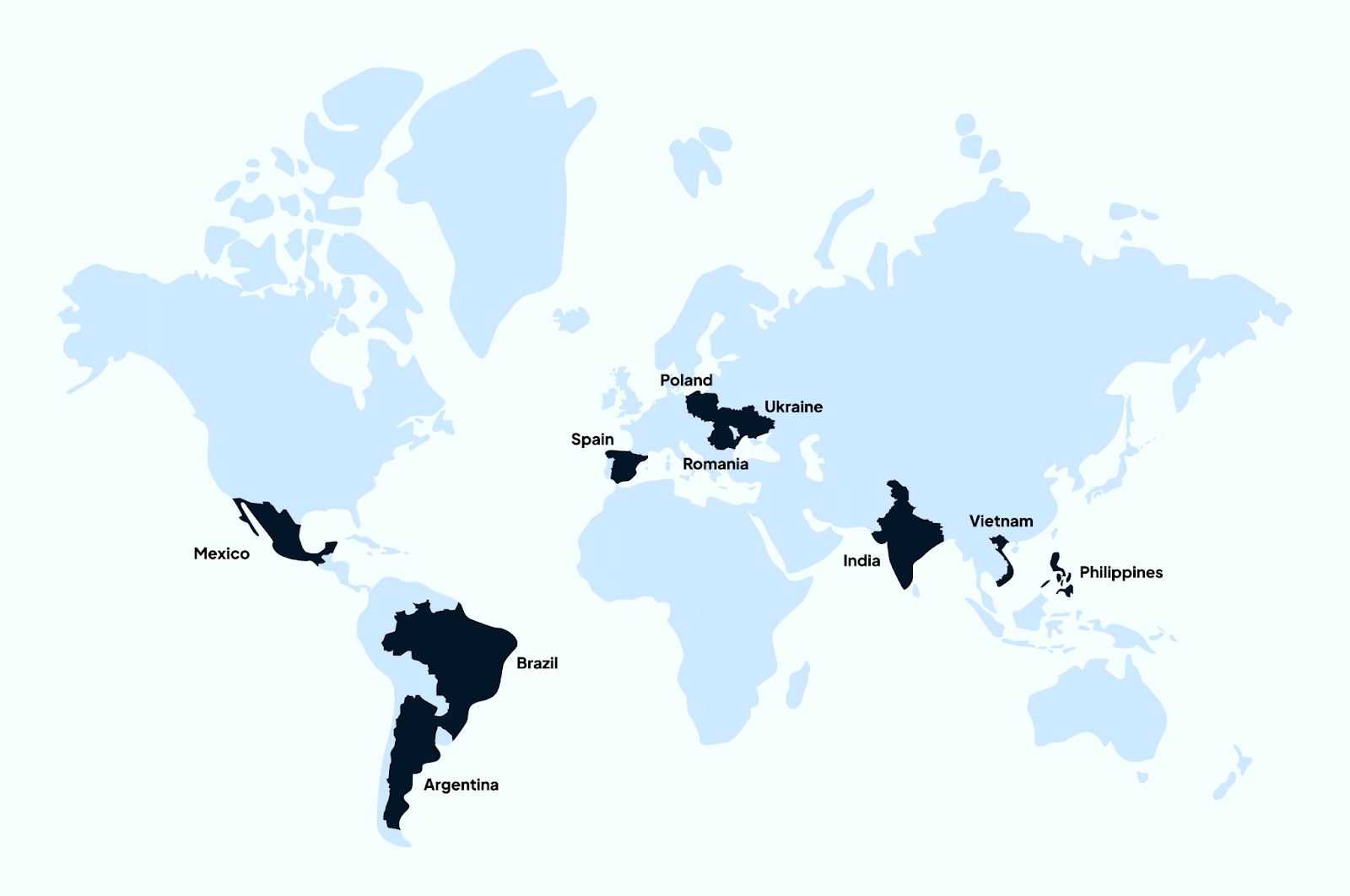
Poland has firmly established itself as one of Europe’s most reliable software outsourcing hubs. With hundreds of thousands of IT professionals and a robust technical university system, Poland consistently ranks high in global developer skill benchmarks.
Its EU membership ensures regulatory stability and GDPR compliance, making it particularly attractive for European companies. Poland is known for strong backend engineering, enterprise systems, fintech solutions, and cybersecurity expertise.
While costs are higher than in some Asian destinations, the balance of quality, proximity, and reliability makes Poland a premium outsourcing choice.
Best for: European companies and enterprise software projects
Hourly rates: $40–$70
Strengths: highly skilled engineers, EU compliance, mature tech ecosystem
Challenges: higher development costs than Asian outsourcing hubs
Ukraine has earned a strong reputation for advanced engineering talent and technical rigor. Ukrainian developers are widely respected for their problem-solving abilities and product-focused mindset.
The country has deep expertise in fintech, SaaS platforms, blockchain, gaming, and AI-driven applications. Many Western startups rely on Ukrainian teams for high-complexity product builds.
Despite geopolitical challenges, the Ukrainian tech sector has demonstrated resilience and continued global collaboration.
Best for: startups and complex software platforms
Hourly rates: $35–$60
Strengths: deep engineering expertise, strong problem-solving culture
Challenges: geopolitical instability
Spain is increasingly recognized as a strategic outsourcing destination within Western Europe. While it may not compete with Eastern Europe or Asia purely on cost, it offers exceptional value in collaboration quality, product thinking, and innovation maturity.
Cities like Madrid and Barcelona have thriving startup ecosystems, producing strong SaaS, fintech, and e-commerce talent. Spain’s regulatory stability within the EU, cultural alignment with Western companies, and time zone compatibility make it particularly attractive for organizations prioritizing close collaboration and strategic alignment.
For businesses that value product ownership and seamless communication, Spain presents a compelling option.
Best for: EU-based collaboration and product-focused development
Hourly rates: $50–$90
Strengths: strong startup ecosystem, product mindset, regulatory stability
Challenges: higher development costs
The Philippines is traditionally known for business process outsourcing, but its software development sector continues to grow rapidly.
What sets the Philippines apart is its communication strength. English fluency and cultural compatibility with Western companies make collaboration smooth and efficient.
It’s an attractive destination for companies looking to combine software development with customer-facing technical support or ongoing product maintenance.
Best for: collaborative teams and long-term partnerships
Hourly rates: $25–$50
Strengths: excellent English communication, strong work culture
Challenges: smaller developer talent pool compared to larger markets
Vietnam is one of Southeast Asia’s fastest-growing tech ecosystems. Government investment in digital infrastructure and STEM education has accelerated its emergence as a competitive outsourcing hub.
Vietnam offers strong capabilities in web and mobile development, quality assurance, and custom software builds at competitive rates. Its young workforce and startup-driven culture make it particularly appealing to early-stage companies seeking agility and affordability.
Best for: startups and cost-efficient development teams
Hourly rates: $20–$40
Strengths: competitive pricing, fast-growing tech sector
Challenges: fewer senior engineers compared to mature outsourcing markets
Romania continues to attract European and North American companies seeking skilled engineers within the EU framework.
Romanian developers are multilingual and highly adaptable, with strong experience in enterprise applications, automotive software, cybersecurity, and fintech systems. As an EU member state, Romania provides regulatory alignment and data protection assurance for companies operating in European markets.
Its cost-to-quality ratio makes it a strategic mid-range option for businesses prioritizing stability and expertise.
Best for: EU-based development teams and enterprise software
Hourly rates: $40–$65
Strengths: multilingual engineers, strong technical education
Challenges: rising developer salaries
India remains the global leader in software development outsourcing. Its talent pool is unmatched in scale, offering millions of developers across virtually every technology stack.
India’s strength lies in scalability. Large enterprises rely on Indian teams to manage complex digital transformation initiatives, AI implementation, cloud infrastructure, and enterprise software modernization.
While this breadth and cost efficiency are attractive, working across time zones and varying work cultures can require structured processes. Quality and experience can also vary between teams, so proper vetting is important.
Best for: enterprise-scale development and large engineering teams
Hourly rates: $20–$45
Strengths: cost efficiency, massive talent pool, diverse technology expertise
Challenges: time zone differences, communication and cultural alignment, variable team quality
Brazil is the largest tech hub in Latin America and a growing nearshore destination for North American companies. Technical expertise spans data science and machine learning, cloud computing and SaaS platforms, and complex enterprise-level systems, making it a good fit for data-intensive products, large engineering teams, or projects requiring senior developers experienced in complex architectures.
Best for: nearshore development, data-intensive projects, and senior engineering teams
Hourly rates: $20–$50
Strengths: large tech workforce, fintech and mobile expertise, active startup culture
Challenges: labor and regulatory complexity, cost volatility
Mexico has become one of the most attractive nearshore outsourcing destinations for U.S. companies.
With growing tech hubs in cities like Guadalajara and Mexico City, Mexican developers have experience building enterprise software, SaaS platforms, and digital products for international companies.
Best for: U.S. companies needing nearshore development teams
Hourly rates: $40–$70
Strengths: geographic proximity, large tech workforce, bilingual developers
Challenges: higher costs than Asia, regional security considerations
Argentina has built a reputation for producing highly skilled developers with a strong analytical foundation and a creative approach to problem-solving. Its tech community shines in areas like AI, machine learning, blockchain, and algorithmically complex projects, making it a solid choice for specialized, high-tech work.
However, economic ups and downs can affect longer-term contracts, and labor regulations can be tricky, so flexibility and careful planning are important.
Best for: specialized, AI-heavy, or technically complex projects
Hourly rates: $35–$60
Strengths: high-quality coding talent, agile mindset, time zone alignment
Challenges: economic volatility, labor regulations
The best country ultimately depends on your priorities.
If regulatory alignment, product-focused teams, and close collaboration matter most, Spain and parts of Eastern Europe offer strong options. For teams prioritizing seamless communication and long-term partnerships, the Philippines and other Southeast Asian hubs offer competitive advantages.
Geography, however, is only part of the equation.
The real differentiator is choosing a partner that understands your product vision and long-term growth objectives. Many organizations choose to hire offshore developers through structured engagement models that ensure transparency, accountability, and measurable output.
A strong outsourcing relationship feels less like vendor management and more like an integrated extension of your internal engineering team.
Software development outsourcing is becoming a lifeline for companies that want to move fast and stay competitive. Long-term partnerships with dedicated teams are becoming the norm. The teams know your workflows, your priorities, and your vision. You still call the shots, but you’re not juggling every single detail.
Technology is changing how outsourcing works, too. Artificial intelligence, cloud computing, and advanced collaboration tools are making remote development more efficient and transparent than ever. Agencies and dedicated teams are increasingly leveraging these tools to ensure faster delivery, higher quality, and real-time communication.
Looking ahead, outsourcing will be defined by agility, expertise, and innovation. Companies that embrace global talent, combine it with modern collaboration technologies, and build long-term partnerships will not only reduce costs but also gain the flexibility, expertise, and innovation needed to thrive in the years ahead.
Every country, every team, carries its own approach, its own way of thinking about problems and solutions. Yet many companies treat outsourcing like a spreadsheet: cost, skills, availability. That approach is why so many projects stall or underperform.
The people you hire across the globe influence your company’s future just as much as—or sometimes more than—those you hire nearby.
Moving faster, thinking bigger, and creating products that truly stand out starts with seeing the world through the eyes of your team. The sooner you do that, the sooner your company discovers how much further it can go.
.png)

%20(1).png)
.png)
%20copy.webp)
Top%2010%20HealthTech%20Trends%20Shaping%20the%20Future%20of%20Healthcare%20in%202026_.png)