Thanks!
If you liked this, we would love for you to share it with more people.


.png)

It’s easy to fall into assumptions. When comparing custom healthcare software vs off-the-shelf software, off-the-shelf solutions are often seen as fast and simple, while custom solutions in healthcare software development are automatically assumed to be better.
In this guide, we’ll break down what each approach delivers and the trade-offs to watch for. Let’s start with off-the-shelf solutions.
An off-the-shelf software is a ready-made software that many organizations can use as is. It comes with standard features to handle general business needs and can be set up quickly.
Think of it as a one-size-fits-most jacket: it works for many, but may not fit perfectly in every organization. These tools typically allow limited configuration, such as custom fields or minor workflow adjustments, but there’s only so much you can bend without breaking the fit. Integration is handled through vendor-provided APIs, which vary in flexibility, and you are subject to the vendor’s roadmap for updates and fixes.
Custom software, in the realm of healthcare software development, is built around your organization’s specific workflows, clinical processes, and operational needs. It integrates directly with EHRs, billing systems, laboratories, and telehealth platforms, with compliance requirements such as HIPAA or GDPR embedded into the workflow by design.
Sure, it takes more time and a bigger upfront investment, but it grows with your organization, giving you full control over features, timelines, and updates.
At Starshot, we specialize in healthcare software development tailored to your needs using an iterative, Agile approach. We provide updates and track progress through Jira, Trello, or Teams, ensuring visibility into modules impacting EHR integration, scheduling, or patient engagement.
Quality assurance is embedded throughout, with performance checks and contingency plans to manage unexpected challenges. Projects typically begin with a Minimum Viable Product (MVP) focused on core functionality, then evolve based on real-world use and operational feedback to ensure alignment with workflows, existing systems, and long-term strategic goals.
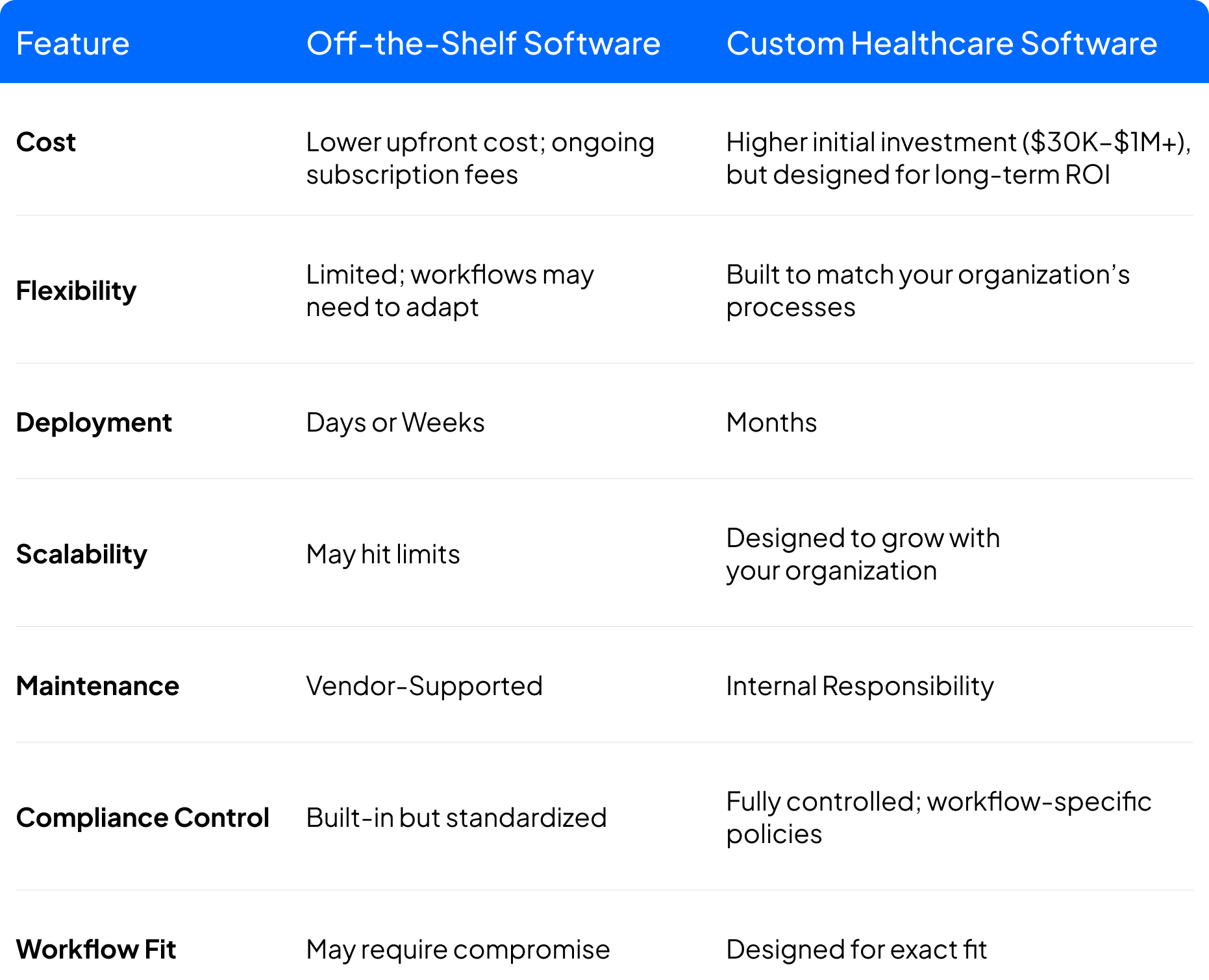
Before diving into the specific factors that should guide your decision in this custom vs off-the-shelf healthcare sofware comparison, did you know 85–90% of features in most software products never get used?
That’s exactly why choosing software without understanding your organization’s unique workflows, integration needs, and compliance requirements is risky.
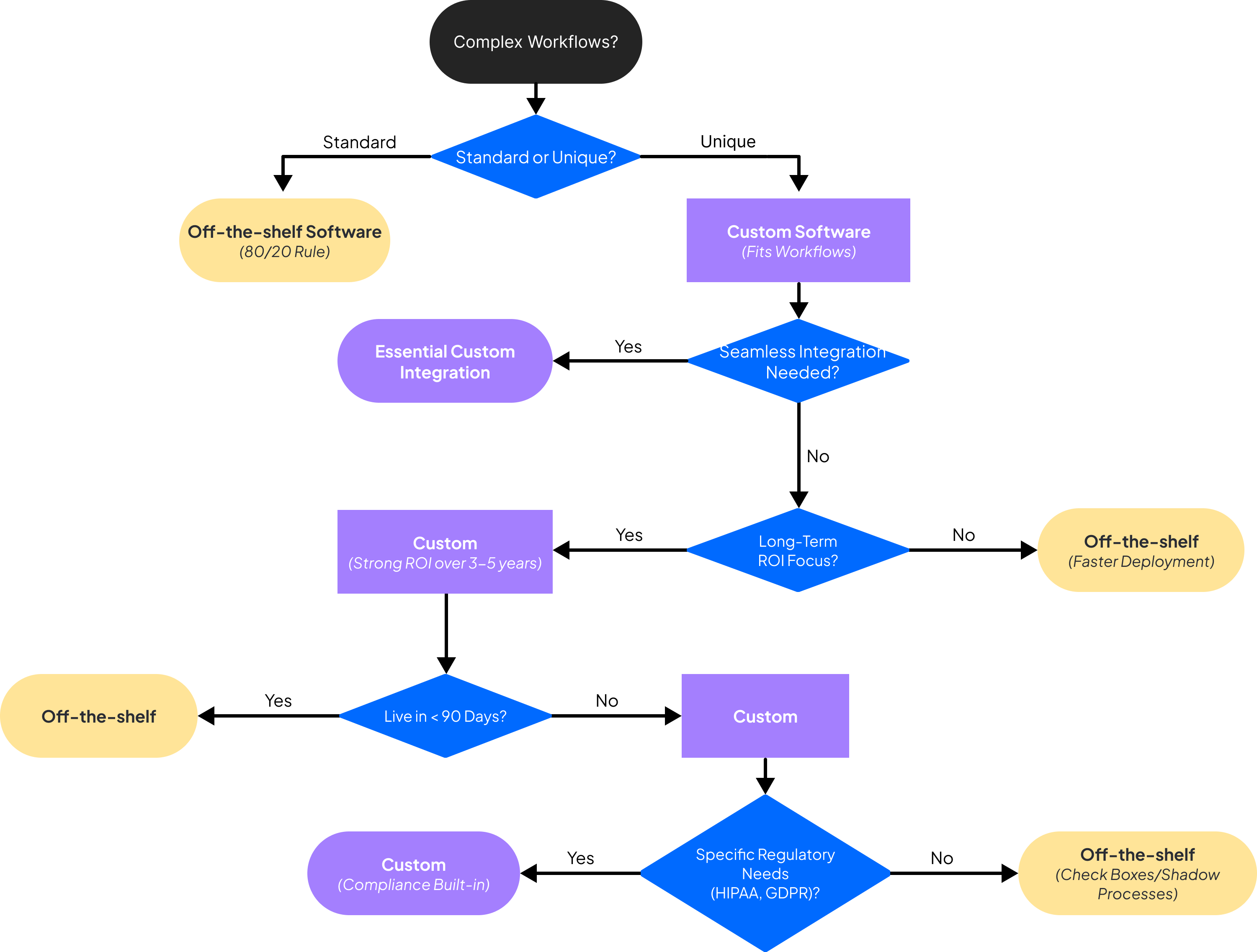
Start with the basics: how big is your organization, and how complicated are your workflows?
If most processes are standard, an off-the-shelf solution may suffice, but unique workflows often require custom healthcare software, highlighting the benefits of custom healthcare software in complex environments. A helpful guide is the 80/20 rule: if a ready-made solution meets 80% of your core needs, it may be faster and more efficient.
Remember: your software should adapt to your team, not the other way around.
Once you understand your complexity, the next question is: how does this software fit into your ecosystem? Healthcare systems rarely operate in isolation. Electronic Health Records (EHRs), billing platforms, labs, and telehealth solutions all need to share information seamlessly.
Off-the-shelf solutions may have prebuilt integrations, but they are often limited to common platforms, and unsupported integrations may require workarounds that are cumbersome or introduce technical debt, a common issue when dealing with off-the-shelf healthcare software limitations.
While cost is an obvious factor, focusing solely on upfront expenses can be misleading. You must consider the total cost of ownership (TCO).
Long-term financial considerations include:
Custom solutions generally have a higher upfront investment and longer deployment timeline, but they reduce workarounds and inefficiencies over time, often delivering a strong ROI over a three- to five-year period.
Off-the-shelf solutions deploy faster and cost less upfront, but subscription fees, limitations, and patchwork adaptations can make them more expensive in the long run.
Takeaway: short-term savings can turn into long-term pain if you don’t think strategically about budget in the context of workflows and integration.
Healthcare organizations evolve—they add departments, expand services, or take on more patients. If your software can’t scale with you, it becomes a bottleneck and a risk.
Custom solutions can grow alongside your organization. You can expand features, add integrations, or tweak workflows without tearing apart the system.
Off-the-shelf software eventually hits a ceiling, requiring migration or expensive add-ons.
HIPAA, GDPR, and other regulations are complex, and how your team handles data depends on your actual workflows.
Custom healthcare software gives you control over encryption, access, auditing, and workflow-specific security policies, so compliance is built in. An off-the-shelf software may check the compliance boxes, but if it doesn’t match your workflow, your team ends up creating shadow processes to stay legal.
Whether you’re building custom healthcare software or buying off-the-shelf, each path comes with trade-offs, depending on your healthcare software customization vs ready-made solutions approach.
Custom software sounds ideal, and often it is. But it still carries its own risks. Scope creep can emerge when requirements change or expand during development, which can extend timelines and increase costs. Budget overruns may follow if initial requirements aren’t clearly defined, and technical debt can accumulate if development standards aren’t maintained, making future updates more difficult.
You also rely heavily on your developers; losing key team members can disrupt continuity unless knowledge transfer is planned from the start.
Off-the-shelf software brings another set of compromises. It’s faster to deploy, but rarely fits perfectly. Limited customization can force your teams to adjust workflows rather than the software adapting to them, which can create inefficiencies or workarounds. Feature gaps or integration limitations with EHRs, labs, billing, or telehealth systems can add hidden costs or complexity. Vendor dependency also poses risk: changes in pricing, feature roadmaps, or product discontinuation can disrupt operations and force unexpected adjustments.
The bottom line is that neither approach is universally better. Both require careful planning for adoption and change management; otherwise, even the right choice can underperform.
The goal isn’t to eliminate risk but to help you understand the trade-offs and make an informed decision on how to choose healthcare software that fits your workflows, integration needs, and long-term goals. In many cases, a blended strategy delivers the right balance of flexibility, speed, and control without introducing unnecessary operational risk.
Starshot Software partners with healthcare organizations to develop custom EHR software and other tailored solutions, designing and scaling digital platforms that align with clinical goals and operational requirements. Our capabilities include:
We focus on building systems that not only improve care delivery today but also support innovation and growth over time. For example, with Narus Health, we developed a mobile app to support patients receiving palliative care. The app provides secure access to reports, prescription tracking, and real-time communication with clinicians, while integrating with the organization’s existing workflows. This approach improved patient engagement and helped the company grow and reach new markets.
Updating your technology or looking at new digital solutions can be complicated. There’s a lot to consider—how your workflows run, how systems integrate, and what compliance rules apply. Understanding how to choose healthcare software comes down to aligning your tools with your workflows, integration needs, and long-term goals. Our team of product strategists, engineers, and healthcare technology experts supports everything from discovery and workflow analysis to full platform development.
.jpg)