Thanks!
If you liked this, we would love for you to share it with more people.




Have you ever wondered how much it actually costs to build an app for iOS, Android, or both? It’s one of the first questions businesses ask when planning a mobile product—and one of the hardest to answer with a single number.
The reason is that app development costs are driven by much more than the number of screens or features. The platform, technical architecture, backend services, integrations, security requirements, performance expectations, and development team can all have a significant impact on the final budget.
So rather than giving you one arbitrary number, let’s look at the typical cost ranges for different types of apps and what drives those differences.
If you’re planning to launch a mobile application this year, the budget is probably one of the first things you want to understand. While there’s no single price that applies to every app, 2026 market ranges can give you a useful starting point for planning.
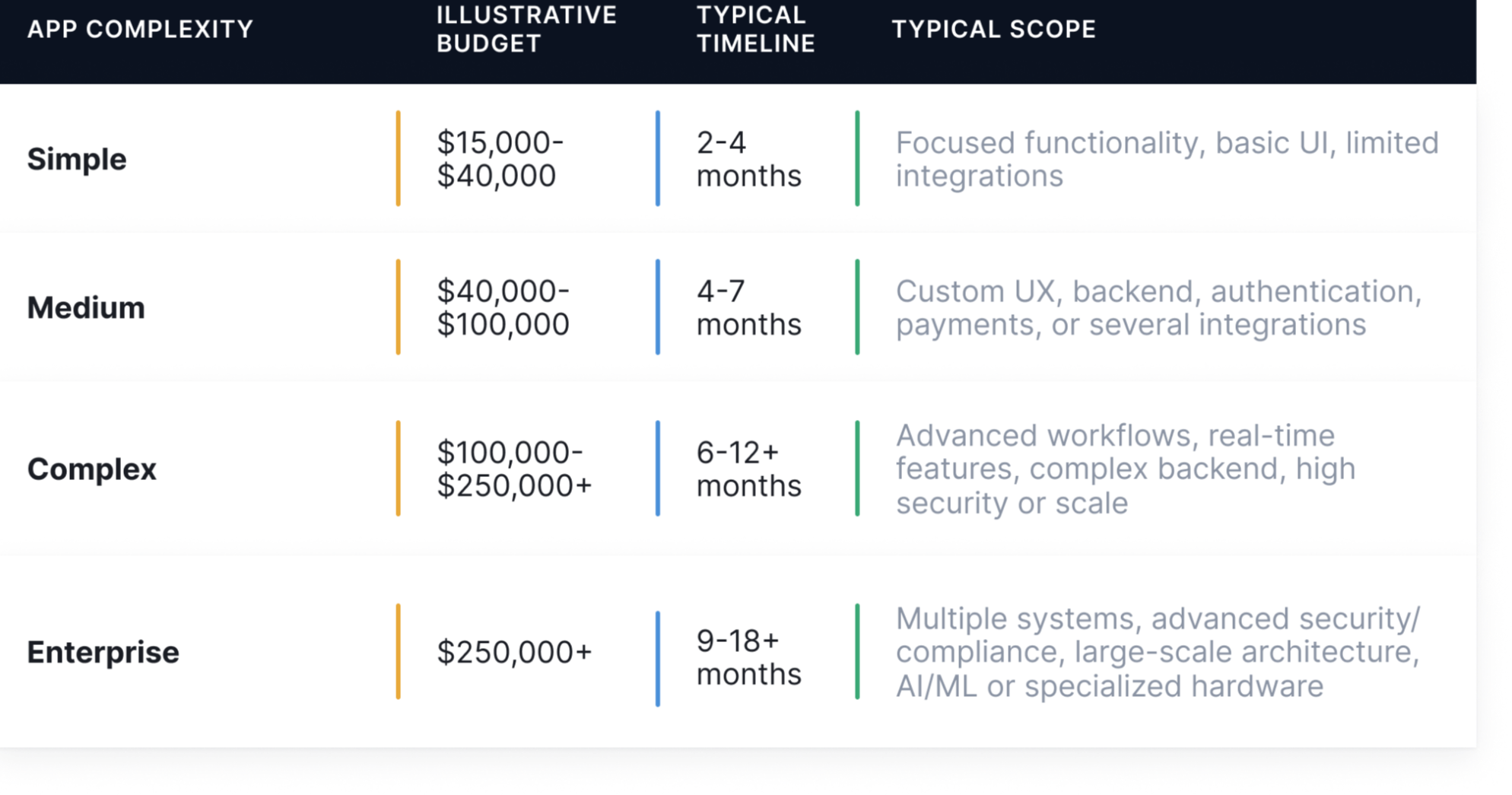
A mobile app can cost roughly $15,000 for a relatively simple product and $250,000 or more for a complex, custom application. The difference comes down to the scope, technical complexity, and level of quality and reliability the product requires.
For many businesses, the most useful way to estimate cost is not to start with a single industry-wide average. Start with the scope: what are the functional requirements? Who are the end users? What backend services, APIs, and third-party integrations are involved? What are the security, scalability, and performance requirements? And which platforms and environments does the app need to support? Once you have those defined, you can build a much more realistic cost estimate.
It boils down to the sheer amount of specialized work required to design, program, test, and maintain your product. Here are the main factors that dictate your final quote:
A relatively simple informational app can have a very different scope from an e-commerce platform, marketplace, subscription service, or on-demand application. The business model often introduces additional requirements, such as payments, subscriptions, user roles, notifications, search, analytics, administrative tools, and third-party integrations.
Monetization can also affect the overall scope. If the app includes subscriptions, in-app purchases, advertising, or other paid services, the development team needs to account for supporting payment flows, different account states, permissions, and the backend logic required to manage them.
Defining a tight minimum viable product (MVP) for launch and separating it from the long-term roadmap is the most effective way to control initial development costs.
Design complexity can affect both an app's cost and timeline. A straightforward interface built around familiar patterns is generally less expensive than a highly customized experience.
The design budget can increase when the product requires user research, detailed user flows, prototypes, custom animations, complex interactions, accessibility work, extensive usability testing, or different experiences across devices and screen sizes.
Revision cycles matter too. Testing a prototype and resolving usability issues early is usually less expensive than discovering after development that an important workflow needs to be redesigned.
For this reason, the cost of UI/UX isn't simply about how much design is produced. It also depends on how complex the experience is and how early the team can validate the decisions that shape it.
Features in an app can have very different development requirements, even when they appear equally simple from the user's perspective.
Take payments as an example. Adding a payment button to the interface is relatively simple. Supporting payments can involve subscriptions, refunds, failed transactions, security requirements, backend logic, and integration with a payment provider.
The same applies to features such as messaging, video, search, analytics, AI, and third-party APIs. Using an established service can reduce what needs to be built from scratch, but integration, customization, testing, and ongoing service fees still need to be considered.
The infrastructure behind these features can also affect the cost of running the app. An application handling large amounts of data, transactions, real-time activity, or multiple integrations will require more resources, and those costs can increase as usage grows.
Costs increase when features become closely tied to an application's core business processes. Payments, subscriptions, offline synchronization, and real-time communication can require more sophisticated backend systems and more coordination between different parts of the product.
For example, offline synchronization may appear simple from the user's perspective, but the system still needs to reconcile locally stored data with server data when users reconnect. Payment functionality similarly involves more than connecting a payment gateway. Failed transactions, refunds, account states, and other conditions all need to be handled reliably.
As functionality becomes more central to the business, more of the development cost shifts from the interface to the engineering required to make the underlying process work reliably.
Advanced mobile features can affect both development costs and ongoing operating costs. AI assistants, video streaming, and IoT connectivity often rely on third-party APIs, cloud infrastructure, data storage, and device integrations that continue to generate costs after launch. An AI assistant, for example, can incur API and infrastructure costs with every interaction, while video streaming increases storage and bandwidth costs as usage grows. IoT features can also require ongoing support for different devices and connectivity conditions. For that reason, these features should be evaluated as both development investments and ongoing operating costs, with infrastructure and usage growth factored into the budget from the start.
Security requirements can change the economics of an app, particularly when the product operates in a regulated environment. A healthcare app, for example, may need to meet requirements that affect where data is stored, which vendors can be used, how systems exchange information, and how access is managed.
That can narrow the technical options available to the development team and sometimes require more expensive infrastructure or services. It can also affect which third-party integrations are viable, since not every provider will meet the product's security or compliance requirements.
Based on these drivers, here is how different levels of complexity translate into typical market budgets and timeline:
The choice between native and cross-platform development affects more than the initial build estimate. It determines your time-to-market and shapes how much effort goes into maintaining the app over its lifespan—a phase that typically consumes 15% to 20% of the initial development budget annually.
If you're building for both iOS and Android, cross-platform development can reduce upfront costs when a large portion of the code and functionality can be shared between the two platforms. Instead of building the same feature twice, the development team can reuse much of the application logic and interface across both versions. This can reduce duplicated engineering work and make future updates more efficient.
But those savings aren't guaranteed.
If the app relies heavily on platform-specific functionality, custom native integrations, or demanding performance requirements, developers will still need to write and maintain separate code. The more platform-specific work required, the smaller the initial cost advantage becomes. Furthermore, choosing cross-platform purely to reduce the initial quote can become a financial liability later if the team repeatedly needs to build costly workarounds for framework limitations.
Native development requires a higher upfront budget and may stagger your initial platform launches, as separate iOS and Android applications must be built. However, it can make clear financial sense—and reduce long-term technical debt—for products where platform-specific performance, hardware access, or highly customized experiences are central to the value proposition.
Choosing cross-platform purely to reduce the initial quote can become more expensive later if the team repeatedly needs to work around framework limitations or maintain substantial platform-specific code alongside the shared codebase.
To accurately compare costs, evaluate the Total Cost of Ownership (TCO) across three core business phases, rather than relying just on the initial development estimate:
Xamarin should no longer be selected for new projects. Microsoft ended support for Xamarin on May 1, 2024. Organizations maintaining existing Xamarin applications should evaluate migration to a currently supported technology where appropriate.
Hourly rates are often the easiest number to compare, but they only represent one part of the equation. Recruitment, management, coordination, ramp-up time, and rework can all influence how much it ultimately costs to take an app from concept to launch.
In-house teams give you control. Product knowledge stays inside the company, communication is direct, and the team can grow with the product. The trade-off is the cost of building and maintaining that capability internally. Beyond salaries, there are recruitment, benefits, tooling, management, and onboarding costs. For companies building a long-term product organization, that investment can make sense. For a single application or a time-sensitive launch, however, assembling a full team internally may add high cost and delay before development even begins.
Freelancers can offer a more flexible and cost-effective option, particularly when the scope is well defined, or a project requires a specific area of expertise. The challenge is that mobile app development rarely stays within one discipline. As complexity increases, a project may require mobile and backend development, UX/UI, QA, DevOps, and product management. When those capabilities are spread across multiple independent contributors, someone still needs to coordinate the work, align decisions, manage dependencies, and ensure the pieces come together as one product.
A software development agency or outsourced product team approaches the same problem differently by bringing multiple disciplines together as a coordinated delivery team. Rather than building every capability internally or managing several independent contributors, a company can access the expertise needed for the project within a single delivery structure. That can be particularly useful when a product requires several specialized roles from the beginning or when reducing time to market is a priority.
Ultimately, the right model depends less on the lowest hourly rate and more on the total cost of delivery. A meaningful comparison should account for team experience, ramp-up time, coordination, development speed, QA and security practices, communication, intellectual-property ownership, and ongoing maintenance.
A lower rate isn't necessarily cheaper if it means a longer timeline, more management, or expensive rework later.
The launch budget is only part of the total cost of owning a mobile app. Once the product is live, the cost shifts from building the first version to keeping it running, secure, reliable, and useful as the business grows.
Most post-launch costs fall into three main areas.
Every app has services running behind the interface. Depending on the product, that may include cloud hosting, databases, file storage, bandwidth, content delivery, APIs, analytics platforms, authentication services, SaaS tools, and payment processing.
Some of these costs are relatively fixed, while others increase with usage. An app with a small user base may have relatively low infrastructure costs at launch, but those expenses can rise as more people create accounts, upload files, stream content, make transactions, or use features that depend on external APIs.
Third-party services also need to be considered when estimating the real operating cost. Using an existing service can be faster and less expensive than developing the same capability from scratch, but subscription and usage fees then become part of the app's ongoing budget.
Launching the app doesn’t mean the work is done. Operating systems change, third-party libraries are updated, APIs are deprecated, and new devices introduce compatibility issues. Keeping the app stable means continuously updating dependencies, applying security patches, fixing production issues, and regression testing changes before they reach users.
Then there’s everything you need to monitor after launch. Crash reporting, application monitoring, logging, alerting, QA, and security work help you catch problems early and address them before they affect a wider user base. Otherwise, small compatibility or reliability issues can accumulate into larger problems over time.
The first release is rarely the end of the investment. Once the product is in use, customer behavior, business priorities, and new requirements can change what needs to be built and supported. A feature that makes sense at launch may also need to be expanded, replaced, or reworked as the product evolves.
The bigger cost question is what happens when usage changes. Some operating costs scale predictably with users, while others can change based on how heavily specific features are used.
AI is a good example because the cost isn't tied only to how many users you have. It can also depend on how often they use the feature, how much data each request processes, which model is being used, and how much compute the system requires. A change in user behavior, prompt volume, model choice, or workload can materially change the monthly cost of running the product. Model maintenance adds another variable, since AI workflows may require ongoing evaluation, optimization, monitoring, and updates as the product and usage patterns change.
For an AI-heavy product, the relevant question isn't simply what it costs to integrate the technology. It's what the cost structure looks like at 10,000 users, 100,000 users, or a significantly higher request volume. That's where an apparently small feature can become a meaningful recurring liability.
A reliable estimate starts with a written scope. Before asking a development team for a quote, document the target users, business goal, required platforms, core user journeys, must-have features, integrations, security or compliance requirements, expected scale, and desired launch date.
The more clearly these assumptions are defined, the more meaningful the estimate will be. For an early-stage product, consider estimating the MVP separately from the longer-term roadmap so the first release does not become overloaded with features.
Don't let hidden backend complexities or ongoing operational costs derail your budget. Contact Starshot Software to map out a realistic financial roadmap and technical strategy for your next mobile product.