Thanks!
If you liked this, we would love for you to share it with more people.


%20copy.webp)

Intellectual property in outsourcing environments is rarely compromised through a single failure point, especially in intellectual property outsourcing setups where multiple vendors and systems are involved.
In most setups, IP protection is not determined by contracts alone. Agreements such as NDAs and IP assignment clauses establish intent and define ownership on paper, but they do not enforce behavior within execution environments once external contributors are operating inside shared repositories, infrastructure, and tooling. Understanding how to properly protect intellectual property when outsourcing requires going beyond contractual frameworks and into operational control.
In this article, we explain how intellectual property is defined, where it is most exposed, and how it can be protected throughout the outsourcing lifecycle beyond reliance on NDAs alone.
Intellectual property in outsourcing refers to the proprietary assets a company shares with, exposes to, or creates through an external development partner.
In most setups, IP protection is not determined by contracts alone. Agreements such as NDAs and IP assignment clauses establish intent and define ownership on paper, but they do not enforce behavior within execution environments once external contributors are operating inside shared repositories, infrastructure, and tooling. Understanding how to properly protect intellectual property when outsourcing requires going beyond contractual frameworks and into operational control.
Because of this, there is no single control that guarantees IP containment.
In this article, we explain how intellectual property is defined, where it is most exposed, and how it can be protected throughout the outsourcing lifecycle beyond reliance on NDAs alone.
For years, companies relied on non-disclosure agreements as their primary defense.
However, an NDA cannot control how repositories are copied, how files move across collaboration tools, or whether subcontractors gain access through vendor chains. Legal protections establish obligations, but they do not prevent everyday workflows that can expose proprietary work.
Developers may clone repositories to their personal accounts to work offline. Designers may showcase product interfaces in portfolios. Vendors may bring in subcontractors without formal disclosure. Each action may appear routine on its own, but together they expand the surface where intellectual property may leak. Even with agreements in place, companies still struggle to protect intellectual property when outsourcing because the execution often occurs outside of the legal documents.
Legal agreements remain essential, but they are only one layer of protection. Effective IP protection requires operational discipline and technical safeguards that reinforce those agreements.
In outsourced development, intellectual property is not limited to one type of asset. It can fall under different categories, and each category requires a different level of protection, documentation, and access control.
The four main types of IP to consider are:
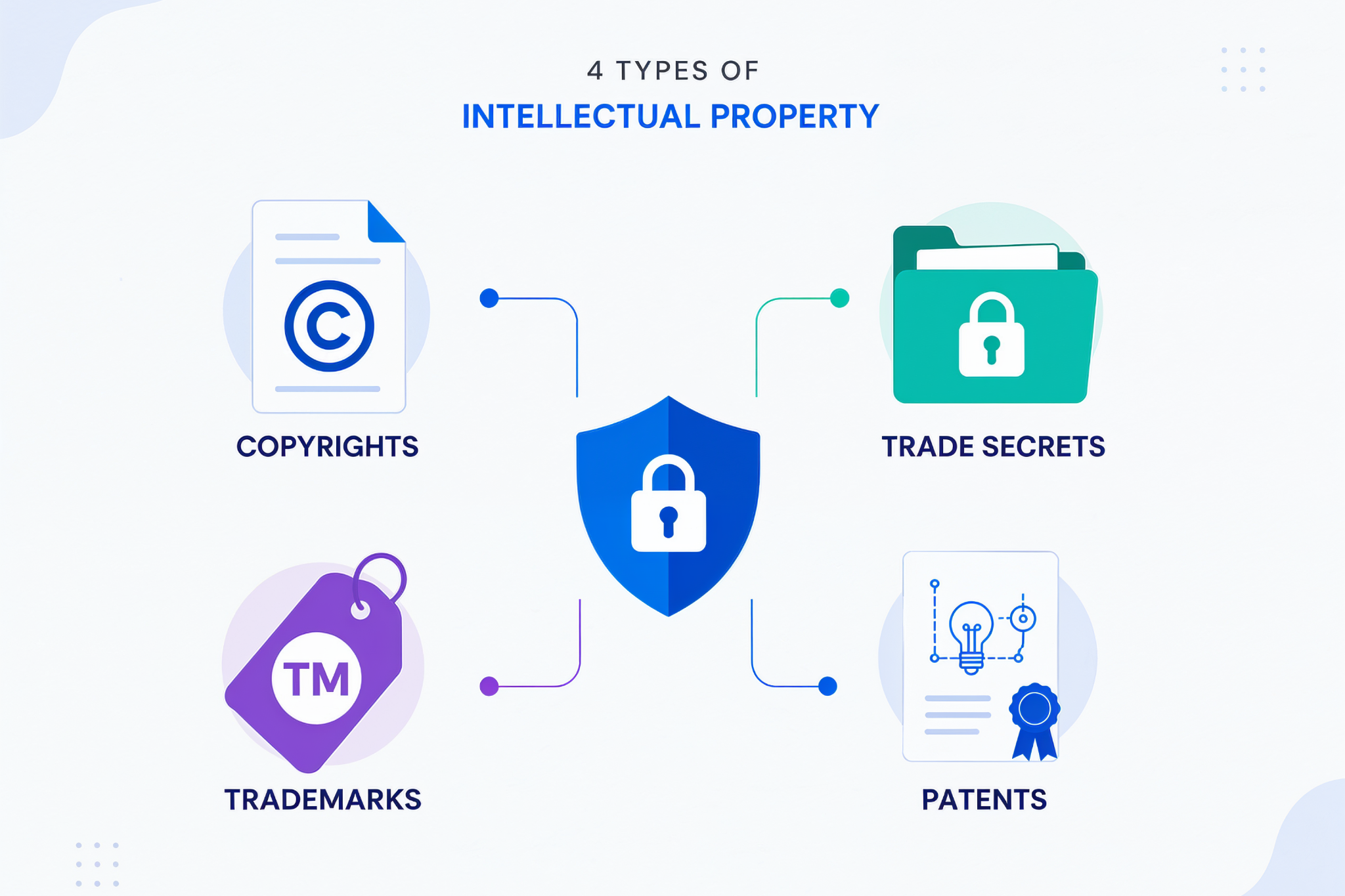
Copyright protects original works created during development. In software outsourcing, this often includes source code, written documentation, UI/UX designs, technical manuals, and product content.
In outsourcing arrangements, copyright is not automatically transferred through payment or project funding. By default, the creator retains ownership unless there is a clear contractual assignment. Without explicit assignment terms, vendors may retain legal rights over the materials they produce, even when those outputs are built for a client’s product.
Trade secrets refer to confidential business information that provides a competitive advantage because it is not publicly known or easily replicated. In software and digital products, this includes algorithms, data models, pricing logic, internal processes, proprietary workflows, and sensitive business information such as client lists.
Trade secret protection depends entirely on maintaining confidentiality. Once exposed without adequate safeguards, the information loses its protected status, and the competitive advantage it provides can be permanently compromised.
Trademarks protect brand identifiers that distinguish a business in the market, including logos, product names, brand names, slogans, and other distinctive visual or verbal elements. In outsourcing contexts, trademarks ensure that brand assets remain consistent and legally protected when used across products, interfaces, and marketing materials developed or handled by external teams.
Patents protect inventions that are novel, non-obvious, and legally eligible for protection, including unique software processes, technical methods, and in some cases, hardware-related innovations.
Patent-related work should be handled carefully because early disclosure, unclear inventor contributions, or poorly documented development history can create ownership and filing issues later.
As development work becomes distributed across multiple teams, control is no longer centralized. Responsibility is spread across different systems, environments, and often across multiple jurisdictions.
Organizations often underestimate the operational complexity this creates. Differences in local regulations can affect how ownership and accountability are enforced. Modern cloud-based toolchains and CI/CD pipelines also make it harder to maintain end-to-end visibility across the delivery workflow. At the same time, multiple contributors working in shared repositories increase the risk of unintended access, code leakage, or mismanagement of sensitive modules.
Risk increases further when subcontractors are brought in without clear visibility into the delivery chain, and when frequent team changes lead to constant updates in repo access, permissions, and environment credentials.
In many cases, issues only surface later during fundraising, acquisition, or technical due diligence. Questions around ownership of specific services, modules, or code contributions can slow down deals and create financial exposure.
A common misconception contributes to this problem. Many leadership teams assume ownership is automatic because they funded the build. Actual ownership depends on proper IP assignment clauses, repository governance, and documented transfer of rights across the development workflow. Without these in place, proving control over the codebase becomes difficult.
For this reason, intellectual property protection should be treated as an end-to-end governance checklist across the outsourcing lifecycle—from repo access and branching strategy to environment control and vendor offboarding.
A structured approach is required if organizations want to consistently protect intellectual property when outsourcing software development across vendors and lifecycle stages.
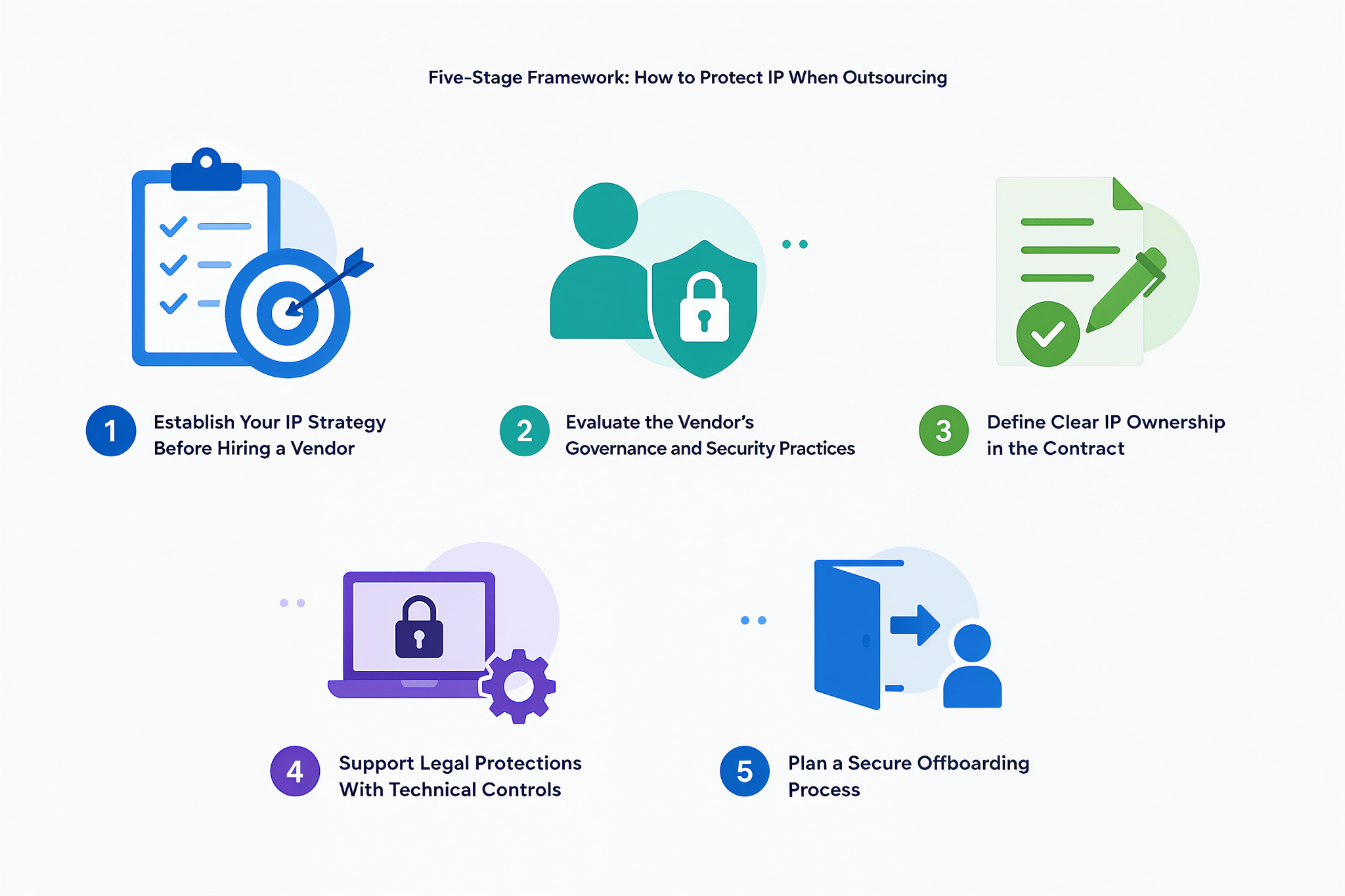
Most teams begin outsourcing with a contract template. A stronger starting point is internal clarity about what must be protected before any agreement is signed.
A focused IP and access audit should address questions such as:
This clarity strengthens contract enforceability and enables practical safeguards.
Contracts define rights, but architectural decisions determine how much of the system becomes visible to external teams.
Relying solely on contracts often leads teams to underestimate how operational dependency develops. Control extends beyond legal ownership of code and includes system knowledge, repository administration, deployment authority, and the ability to operate the product independently.
Without that operational independence, legal ownership alone does not eliminate strategic risk. Structural safeguards can reduce unnecessary exposure by isolating sensitive algorithms behind internal services, using synthetic or anonymized datasets during active development, restricting access to production environments, and dividing work strategically so no single vendor controls the entire architecture.
Technical competence alone does not guarantee maturity in IP or security governance. Plenty of teams can ship features, but far fewer demonstrate disciplined access control, auditability, and subcontractor oversight.
Vendor selection should include a governance assessment alongside technical evaluation. Before granting access to proprietary systems, leadership should evaluate potential partners against defined risk criteria.
Key areas to assess include:
After reviewing these controls, ask direct questions that confirm how they are applied day to day:
Clear and consistent answers signal strong internal controls, while vague responses or vendor choices driven primarily by price and speed point to elevated risk from the outset.
Once governance maturity is assessed, contractual clarity becomes critical. Generic agreements often leave gaps that surface later. Effective IP protection requires language that clearly addresses ownership, derivative works, and exit obligations.
Key provisions typically include:
Remember: Contracts establish the boundaries of ownership. Consistent execution ensures those boundaries hold.
Well-drafted agreements are necessary but not sufficient. Intellectual property protection becomes resilient only when legal terms are supported by technical controls that limit access and create traceability.
Operational safeguards include:
Together, these safeguards shift IP protection from passive documentation to active oversight.
Intellectual property exposure often becomes visible during disengagement. Access may linger, repositories may be duplicated, and documentation may be incomplete.
A structured offboarding process should therefore include:
Exit procedures should follow a formal executive checklist. When offboarding is well structured, it reflects governance discipline applied throughout the engagement.
Even with strong safeguards, intellectual property exposure can still happen. A repository may be copied without approval, confidential documentation may be shared outside the agreed environment, or a vendor may reuse protected work in ways the contract does not allow.
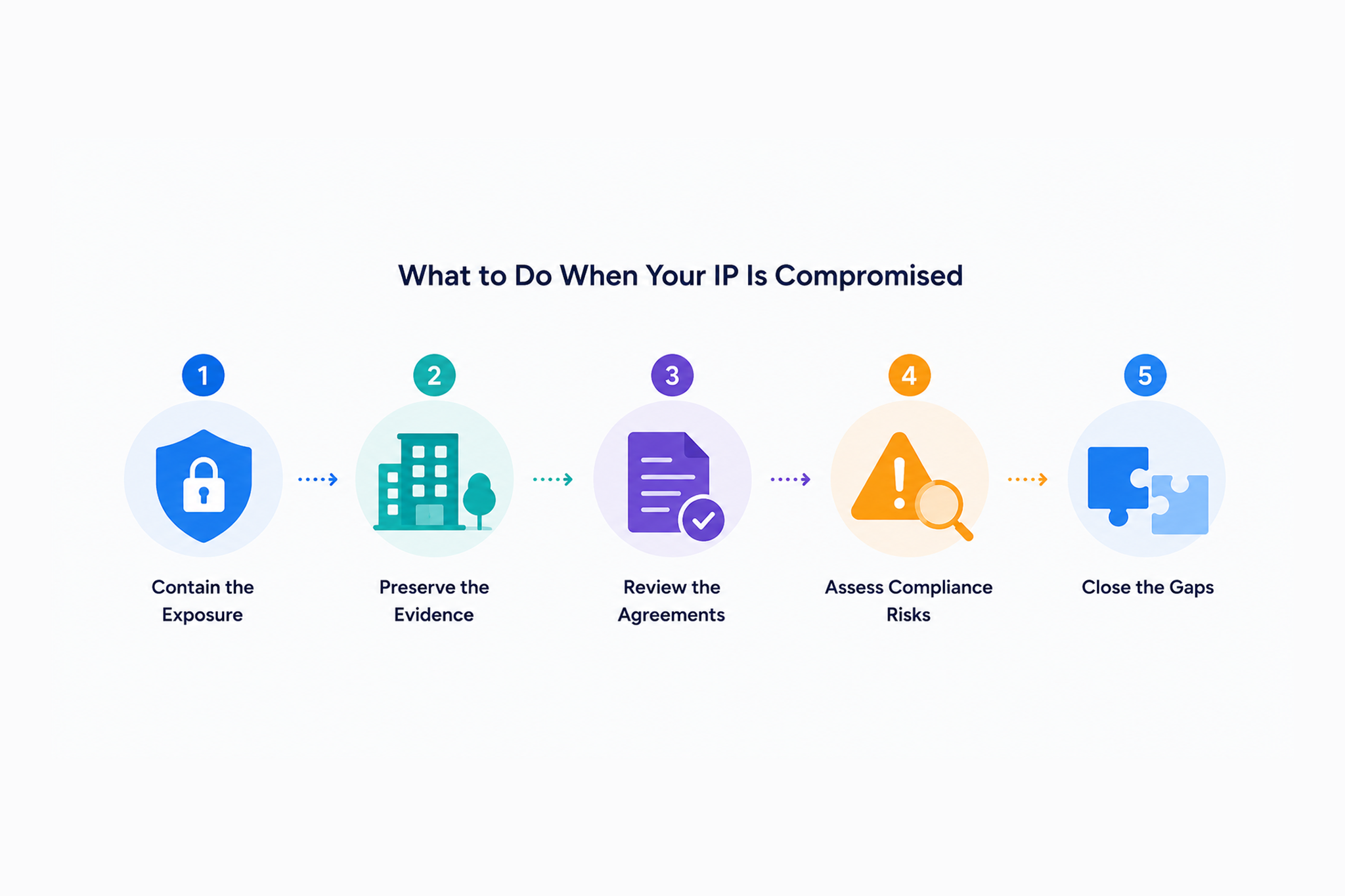
The first step is to contain the exposure. Revoke unnecessary access, rotate credentials, secure affected repositories, and stop further movement of the compromised asset. The goal is to limit additional exposure before investigating the full scope of the issue.
Next, preserve evidence. Keep repository logs, access records, file transfer history, commit activity, communications, and any documentation that shows what was accessed, copied, shared, or reused. These records help determine whether the issue came from excessive access, weak controls, vendor negligence, subcontractor misuse, or breach of contract.
Once the scope is clearer, review the relevant agreements with legal and technical teams. Key documents may include NDAs, IP assignment clauses, subcontractor obligations, non-compete provisions where applicable, and third-party licensing terms. The goal is to understand which rights were affected, what remedies are available, and what actions should follow.
If customer data, regulated information, or sensitive business data were involved, the issue may also require security, compliance, and notification review. Not every IP issue is a data breach, but every incident should be assessed carefully enough to determine whether reporting obligations apply.
After containment and review, use the incident to identify the governance gap. Check whether access was too broad, subcontractors were properly disclosed, repositories were controlled, offboarding was completed, and technical safeguards were strong enough to enforce the contract operationally.
Most IP frameworks fail not at the level of intention but at the level of visibility and control. The real test is not whether IP protection exists in contracts but whether it would still hold if one vendor, one developer, or one environment were removed from the system tomorrow. If the answer is unclear, then IP is not yet fully under control, as it is partially dependent on external participation.
Until then, the real question is simpler: do you actually control your intellectual property, or do you just assume you do?

%20(1).png)

.png)
Top%2010%20HealthTech%20Trends%20Shaping%20the%20Future%20of%20Healthcare%20in%202026_.png)