Thanks!
If you liked this, we would love for you to share it with more people.


.png)

For most institutions relying on legacy systems in banking, the slowdown comes from structural constraints around the core: fragmented data, tightly coupled integrations, and heavy manual coordination. Even when changes reach production, they do so through a process that is increasingly slow, risky, and difficult to control.
The key point is that isolated legacy core banking system modernization does not solve this problem. Unless these structural issues are addressed, a faster or more modern platform will still produce the same delivery delays.
Effective core banking modernization, therefore, begins with diagnosis rather than replacement. The first step is to identify where change is slowing down and why—specifically, which systems create the highest coordination overhead, which dependencies introduce the most delivery risk, and which data issues consistently require manual intervention.
The goal is not just to modernize the core but also to ensure that future changes can be isolated, tested, and released with less friction and greater control.
Legacy banking systems are often highly reliable at the work they were originally designed to handle. They can still process transactions, maintain account records, support balances, and enforce core operational rules. However, the challenge begins when that same system must support faster software releases, real-time data access, modern digital channels, and evolving compliance requirements.
Rigid architecture is usually the first constraint. Many legacy banking systems were built as large, tightly connected environments where core functions depend heavily on one another. A change in one area can affect several others, which makes even minor updates harder to scope, validate, and deploy safely.
Another common characteristic is outdated infrastructure. Some systems still depend on mainframes, older programming languages, or on-premises environments that are expensive to maintain and difficult to scale. These platforms may remain stable, but they often require specialized knowledge and heavier operational support.
Legacy systems also tend to have limited integration capability. New tools, digital channels, and third-party services often cannot connect through standardized APIs. Instead, teams have to build custom links or complex workarounds. Each new connection may solve an immediate need, but it also adds another dependency the bank must maintain during future updates.
Data creates another major constraint. In many legacy environments, information is spread across separate systems with different formats, update schedules, and ownership rules. Many also rely on batch processing, which means data is updated or reconciled at set intervals instead of moving continuously across systems. Before this data can support reporting, customer-facing services, or new product workflows, teams usually have to reconcile it manually. The real delay comes from the effort required to make the data timely, consistent, and usable across the bank.
Over time, quick patches and short-term fixes create code rot and heavy technical debt. These fixes may keep the system running, but they also make the underlying codebase harder to maintain and the architecture harder to simplify. As more layers are added, teams end up spending more effort protecting the current system from breaking, instead of improving how it supports future change.
Modern banking systems are designed around a different expectation. Cloud-native infrastructure, standardized APIs, real-time data movement, scalable services, and stronger security controls help banks introduce change without forcing every update through the same tightly connected environment.
When planning modernization, the more practical question is how much effort each change now requires. A system becomes a modernization constraint when routine updates depend on too much manual coordination across code, data, integrations, and operations.
Knowing your core system is outdated is one thing. Managing the consequences every day is another. If your modernization efforts feel like taking one step forward and two steps back, you're likely facing these hidden structural bottlenecks:
Together, these challenges slow release cycles, increase testing effort, and limit how quickly banks can respond to new requirements.
Technical limitations don't just stay in the IT department; they eventually bleed into every aspect of the bank's operations. Eventually, technical debt becomes a business-wide problem.
When core systems can't adapt, the fallout hits these four critical areas:
As these pressures increase, the system becomes less able to support current business, security, and regulatory demands.
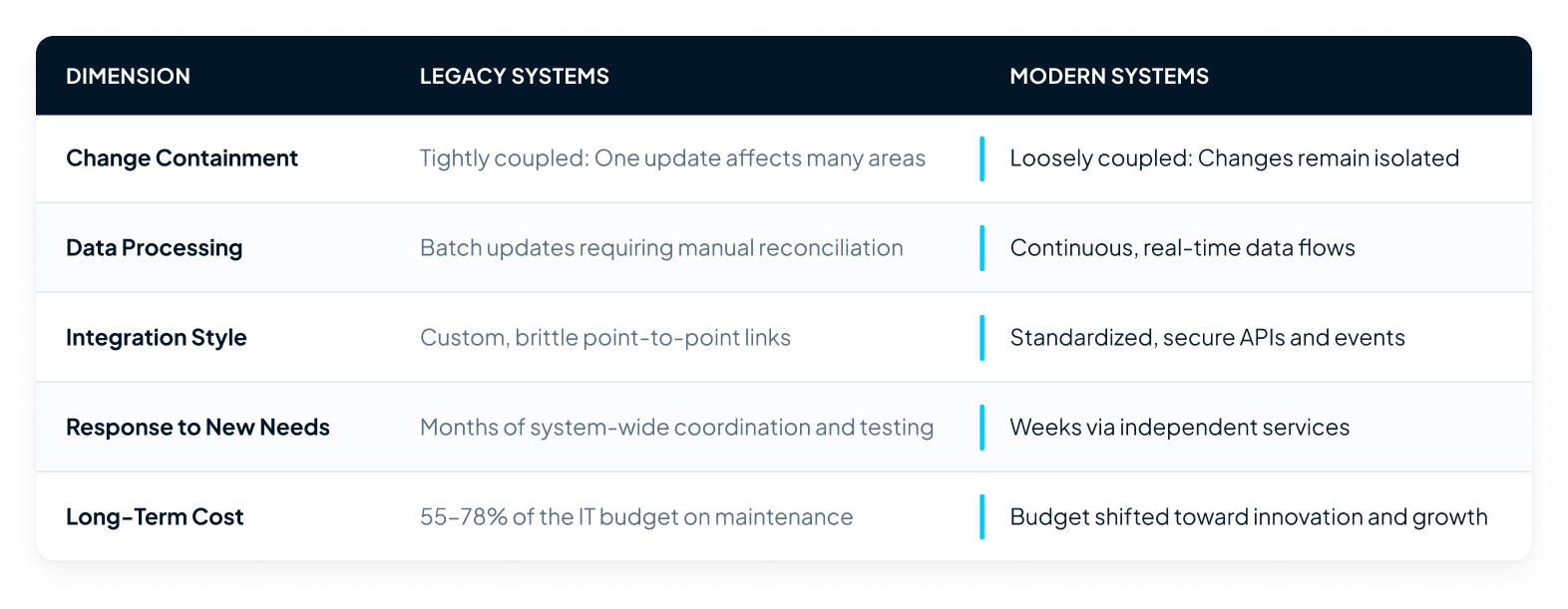
The true benefits of banking system modernization become clear when you look at how each environment handles change. In legacy environments, systems, data, and processes are tightly connected. Even a minor update requires coordinating multiple systems, data sources, and workflows. Because these components are so closely connected, a single change can affect several downstream systems and workflows, driving up both effort and risk.
In modern systems, changes are easier to contain. Teams can update or test specific components without affecting the rest of the environment. This makes it possible to roll out new features and respond to market demands quickly, without the need for large-scale coordination.
The distinction becomes clearer when you look at how each system is set up:
Most modernization efforts introduce trade-offs that are not immediately visible. Improvements in performance, scalability, or delivery speed often shift complexity into other areas such as data consistency, system integrations, and operational coordination. For that reason, understanding these trade-offs early is critical, as it shapes both the modernization approach and the organization’s ability to sustain faster, lower-risk change over time.
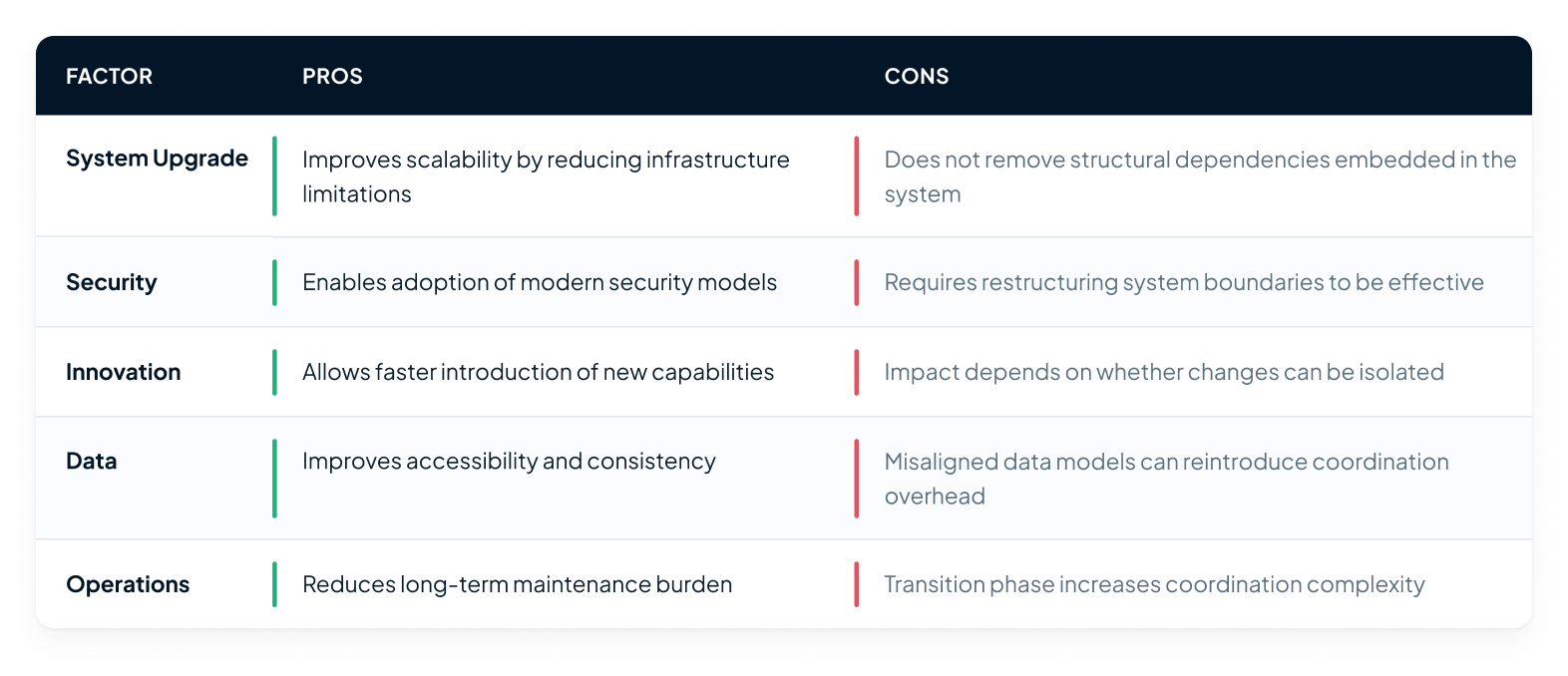
Modernization decisions should be based on how each change affects the effort required for future updates, not just the immediate improvement it delivers.
Modernization strategies are not interchangeable. Each addresses a specific limitation, and choosing the wrong one can increase complexity rather than reduce it. The key is to match the approach to the actual constraint slowing your progress.
Before deciding on a path, banks need to pinpoint where friction is coming from: infrastructure limitations, fragile code, integration bottlenecks, restricted data access, or a core architecture that’s simply too rigid to evolve. Once that becomes clear, the right strategy is much easier to define and far less risky to execute.
Rehosting is often the most straightforward entry point into modernization.
If a bank is dealing with rising infrastructure costs, unstable environments, or limited scalability during peak demand, shifting workloads to modern infrastructure can immediately improve reliability and reduce operational strain. It’s a lift-and-shift approach that changes the foundation without changing the structure.
A practical way to approach this is to start with systems you can afford to move safely: reporting tools, back-office applications, or services that don’t sit directly in the critical transaction path. These give your team room to learn without risking core operations.
However, banks must recognize the limits of this approach: rehosting can make the system run more efficiently, but it does not automatically make the system easier to change. If the application remains tightly coupled and the data remains fragmented, teams will still face the same coordination challenges during future updates.
Refactoring is used when the system still works, but making changes to it has become slow, expensive, or risky.
In these situations, the constraint rarely comes from infrastructure. The root cause is usually the internal structure of the code. Over time, systems accumulate duplication, tightly coupled logic, and inconsistent patterns, which gradually increase complexity until even minor changes require significant effort.
Refactoring addresses these issues by focusing on specific areas of the codebase where complexity creates the highest cost. The intention is not to rebuild the system or improve everything at once but to selectively improve the parts that consistently slow down delivery.
Replatforming is ideal when the system needs better performance, stronger scalability, or more reliable integration with modern services. Unlike a simple rehost, it modifies core parts of the technology environment so the system can support higher transaction volumes or connect more effectively with modern tools.
Teams can begin by identifying capabilities already limited by performance, deployment, or integration issues. For example, services that struggle during transaction growth, depend on outdated middleware, or require too much custom work to connect with newer platforms may be suitable candidates.
The goal is to move selected capabilities into an environment that supports stronger deployment controls, better scalability, and more standardized integration. Internal teams can execute this by setting up a modern API gateway alongside the legacy core, allowing new services to interface safely without disrupting daily operations.
Layered modernization is highly effective when the core system is stable but difficult to change directly. Instead of an immediate replacement, the bank builds a modern software layer around the legacy system through APIs, middleware, or service layers.
It is particularly effective for customer-facing applications, reporting layers, and adjacent services that can be decoupled from core transaction processing logic, as it allows incremental modernization while maintaining operational continuity.
The primary risk here is uncontrolled layering. Adding APIs, middleware, and workarounds without strict governance will only build a new web of dependencies on top of the old system. In the end, this strategy only succeeds when interfaces are documented, secured, and managed as part of the long-term architecture.
Full reengineering is the strongest option when smaller improvements can no longer reduce complexity. At this stage, the main constraint is no longer just infrastructure, code quality, or integration. The core structure itself limits how the bank can change.
Before pursuing this path, internal teams need a clear map of current processes, data flows, integrations, controls, and daily operating requirements. That work should happen before any rebuild begins. The team needs to know which functions are truly core, which processes depend on undocumented logic, and which data rules must be preserved to avoid operational or compliance issues.
Ultimately, full reengineering can create the strongest long-term flexibility, but the process also carries the highest transition risk. Never launch a complete rebuild simply to chase newer programming languages, as technology changes do not solve broken business workflows. Without baseline visibility, the bank may build a new system that carries the same constraints into a different architecture.
The priority is to choose each step based on the constraint being addressed. Modernization works best when every decision reduces complexity and makes future updates easier to manage.
Modernization succeeds if each step makes it easier to introduce change without adding new complexity. The focus must remain on reducing how far updates ripple and how much coordination they require.
1. Map how change behaves in the system: Instead of simply listing components, follow what happens during a single update. Which systems does the update affect, and where do approval, testing, or data issues slow it down? Identifying these friction points reveals the system’s most significant constraints.
2. Prioritize areas that unlock future change: High-value initiatives are not always the best starting point. Some projects are more impactful because they reduce dependencies and make subsequent updates easier. Addressing these early creates the momentum needed for the rest of the system.
3. Set boundaries before building new capabilities: New features built on tightly connected systems inherit existing limitations. Establishing APIs, service layers, and clear boundaries ensures changes stay isolated. This prevents new work from adding to the existing dependency load.
4. Fix data alignment before scaling: If data requires reconciliation before use, every process depends on manual coordination. Ensuring data is consistent and accessible removes a major source of delay. Skipping this step forces new capabilities to rely on temporary workarounds.
5. Introduce change in controlled areas first: Start in parts of the system where dependencies are visible and manageable. This allows teams to observe how changes behave before applying them broadly, reducing the risk of unintended consequences.
6. Transition gradually to maintain operations: Running legacy and modern systems together prevents disruptions to daily business. This dual approach allows teams to roll out improvements while systematically reducing old dependencies over time.
7. Measure progress by "ease of change": The goal is to reduce the effort required for future updates. If changes still require the same level of intense coordination, the system has not improved in a meaningful way.
Starshot works with banks and fintech teams on legacy modernization by helping turn system constraints into clear, workable technical plans that engineering teams can actually execute. We start by looking at where the system is slowing down, whether that’s due to tightly coupled architecture, integration bottlenecks, or fragmented data, and translate that into a practical path forward that engineering teams can actually implement.
From there, the work spans API and integration design, service layer development, modernization of customer-facing applications, and custom web and mobile engineering. Everything is structured around introducing new capabilities without disrupting your core banking operations.
The goal is simple: reduce delivery friction, make systems easier to evolve, and enable faster, safer rollout of new financial products and services.
Legacy banking systems become limiting when every meaningful change—whether operational, regulatory, or customer-driven—requires excessive coordination, long lead times, and elevated delivery risk. At this stage, the constraint is no longer system functionality but the effort required to safely execute change.
Across most institutions, the constraint is not isolated to infrastructure, code, or integration alone. It is the cumulative effect of tightly coupled systems, fragmented data, and operational dependencies that makes change expensive to execute and difficult to control. As these constraints compound, the organization’s ability to respond to business needs slows, even if individual systems remain technically stable.
The most important measure of success is not how modern the technology stack becomes but whether the organization can introduce change with greater speed, lower risk, and tighter control than before.

.png)
.png)
Top%2010%20HealthTech%20Trends%20Shaping%20the%20Future%20of%20Healthcare%20in%202026_.png)
.png)
.png)